DISTRONIC PLUS proximity control (optional)[1] DISTRONIC PLUS helps the driver automatically maintain a specified distance from the vehicle ahead and helps minimise the risk of rear-end collisions by identifying potentially dangerous situations and reacting accordingly. As the sensors can operate between 0.2 and 200 metres the system is also helpful in city traffic or stop-and-go traffic. It can brake the vehicle to a standstill if necessary and also accelerate it again, if confirmed by the driver. In stop-and-go traffic, DISTRONIC PLUS applies the brakes automatically – if necessary, until the vehicle comes to a complete stop. Automatic braking is applied with a deceleration of up to 4 m/s²When the traffic situation improves, DISTRONIC PLUS automatically accelerates back up to the preset speed if the driver presses briefly on the accelerator or flicks the cruise control lever.
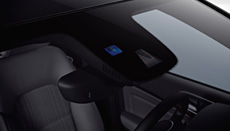
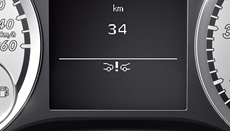
If DISTRONIC PLUS identifies that heavy braking is required, an intermittent warning tone is sounded and a warning symbol lights up on the instrument panel. This alerts the driver to pay close attention and apply the brakes if necessary. To move off again after coming to a complete stop, the driver only needs to pull the cruise control lever or tap the accelerator. 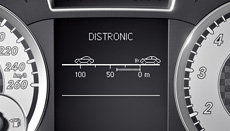
| |
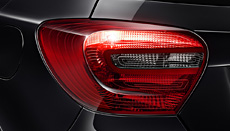
Adaptive brake light, flashing In critical braking situations, specific criteria such as brake pressure and road speed are used to activate the adaptive brake lights if necessary. When activated, the brake lights flash to give drivers behind even better warning of the risk of a rear-end collision. Studies have shown that drivers’ brake-activation response times are shortened by up to 0.2 seconds when emergency braking is indicated by a flashing red warning signal instead of conventional brake lights. At a speed of 80 km/h, this reduction in response time corresponds to a reduction in stopping distance of approximately 4.40 metres. The brake lights flash with a frequency of approx. 3 Hertz (with bulbs) or approx. 5 Hertz (with LEDs). Tests have shown this frequency to be particularly effective.
As soon as the vehicle is moving at less than 10 km/h or has come to a stop, or Brake Assist is no longer active and vehicle deceleration falls below 6.5 m/s² for 150 milliseconds, the brake lights light continuously again.
The adaptive brake light comes on when: - the initial speed is greater than 50 km/h, Brake Assist BAS has recognised an emergency braking situation or the brake pressure is more than 75 percent of the maximum.
- As soon as the vehicle comes to a standstill, the hazard warning signal is automatically activated if the speed was more than 70 km/h before braking was initiated.
| |
Active Parking Assist, including PARKTRONIC (optional) Active Parking Assist makes a major contribution to safe and comfortable driving. It helps drivers find a suitable parking space for parallel parking and helps them to park by active steering intervention. The integrated PARKTRONIC can warn drivers if there are hidden obstacles in front of or behind the car. Active Parking Assist uses two ultrasonic sensors in the front bumper to identify suitable parking spaces when the vehicle is travelling at up to 36 km/h. The automatic parking space search function is indicated by a "P" symbol in the instrument cluster. If Active Parking Assist has found a parking space, an arrow appears next to the "P". By default, Active Parking Assist searches for parking spaces on the right-hand side of the road. If the indicator on the driver's side is active, parking spaces on the left-hand side are also detected
The driver starts the parking manoeuvring process by stopping ahead of the indicated parking space, selecting reverse and confirming the prompt which appears in the instrument cluster. Active Parking Assist then takes over the steering at up to 10 km/h. The driver only has to operate the clutch (in vehicles with manual transmission) and the accelerator and brake. The parking manoeuvre is completed in a maximum of 5 moves. The final parking move is indicated by the message "Parking Assist complete" in the display. This message is accompanied by an acoustic signal. 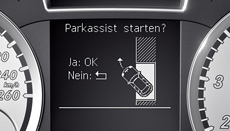
| |
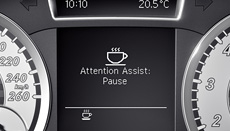
The ATTENTION ASSIST function is particularly helpful on long journeys and when driving at night; the system warns the driver if it detects signs of failing attention and increasing weariness. This driving assistance system can warn the driver when it identifies typical signs of fatigue, which in turn improves handling safety. ATTENTION ASSIST continuously analyses driving behaviour and steering movements. If the system detects certain steering patterns that frequently accompany drowsiness, it warns the driver visually by displaying the "coffee cup" symbol in the instrument cluster at the same time as emitting audible signals. ATTENTION ASSIST can be activated and deactivated in the main menu of the instrument cluster under "Assistance systems". When switched on, it is active at speeds between 80 and 180 km/h. | |
Brake Assist can detect emergency braking situations based on the speed with which the brake pedal is depressed and assists the driver by increasing the brake pressure. The system interprets a certain speed at which the brake pedal is depressed as an emergency situation, and automatically builds up maximum braking power within fractions of a second. Brake Assist is integrated into the Electronic Stability Program (ESP®) and uses its technology to adjust the braking pressure, thereby eliminating the need for additional components. A sensor permanently monitors the speed at which the brake pedal is depressed and transmits this data to the electronic control unit.
If an unusually high pedal speed is registered, the system concludes that there is an emergency braking situation. The system then helps the driver to perform an emergency stop by automatically increasing brake pressure in the wheel brake cylinders. ABS continues to precisely meter the braking power up to the slip threshold, which ensures that steering control is maintained. Once the driver releases the brake pedal, automatic brake boosting ceases immediately. | |
ADAPTIVE BRAKE braking system The standard-specification ADAPTIVE BRAKE system improves ride comfort and safety by helping to perform critical braking manoeuvres more safely using the basic function of the anti-lock braking system (ABS), all within the limits imposed by the laws of physics. At the same time, comfort functions support the driver in everyday operation. - Supporting HOLD function: the optional HOLD function, which is activated by stepping firmly a second time on the brake pedal, can prevent the vehicle from rolling unintentionally when stopped at traffic lights or in stop-and-go traffic.
- Extra help: the Hill-Start Assist function prevents the vehicle from rolling back unexpectedly on uphill gradients when moving from the brake to the accelerator pedal.
- For an even quicker response: The "priming" function shortens the braking response time by priming brake linings whenever you take your foot off the accelerator quickly.
| |
Electronic Stability Program ESP® In critical situations, the Electronic Stability Program ESP® can help to stabilise the vehicle by applying a braking force to individual wheels and by adjusting engine performance. If the ESP® system detects a critical situation, it applies the brakes systematically to one or more wheels according to the situation. Should the system consider it necessary, it will also make an automatic adjustment to engine torque. In this way ESP® helps the driver to stabilise the vehicle within the laws of physics – particularly when cornering and during sudden evasive manoeuvres. - Central feature: the yaw-rate sensor continuously monitors vehicle movement around its vertical axis, and ESP® compares the actual values measured with the optimum desired value, based on the driver’s steering movements and the vehicle’s speed. If the vehicle deviates from the ideal line, ESP® immediately intervenes, working to counteract any swerving movements as they occur.
- Adequate performance at all times: The integral acceleration skid control (ASR) also controls skidding by intervening in engine management reducing engine output as necessary to prevent the wheels from spinning.
- Enhanced safety: ABS as an integral component of ESP® helps to prevent the wheels from locking and to maintain their steering function.
- Additional components: ESP® supplements the functions of the anti-lock braking system (ABS) and acceleration skid control (ASR) by providing a driving stability function.
| |
Headlamp Assist (automatic headlamp activation) -The headlamp assist system reduces the strain on the driver by automatically switching on low-beam headlamps, tail lamps and number plate illumination when it gets dark outside. The assistance system performs this task even when it's raining or snowing via a signal from the rain sensor. The Headlamp Assist system uses a light sensor to measure the light level of the surroundings. If light levels fall below a certain level, low-beam headlamps are switched on. If the light intensity of the surroundings rises again, the low-beam headlamps are switched off again. The system ensures the necessary level of illumination for the vehicle at all times, contributes towards handling safety – in particular under rapidly changing light conditions (e.g. driving into a tunnel or multi-storey car park) – and enhances the driver's comfort. | |
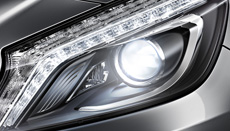
Intelligent Light System (optional) The Intelligent Light System – as an active component of the safety concept – ensures the best possible visibility in all weather conditions and the most diverse traffic situations. With oncoming traffic, illuminated road users, on bends, in fog or on free stretches of road, the system adapts to the situation and adjusts the characteristics of the light individually to that situation. - Brings light to the darkness: in the "country light" mode the light from the low-beam headlamps is distributed such that the edge of the carriageway is significantly better illuminated than with conventional headlamps.
- Increases dynamically: the motorway mode is automatically activated in two steps: from 90 km/h the system boosts the power of the bi-xenon lamps. From 110 km/h the setting of the headlamp on the inside of the traffic lane also changes to illuminate the entire width of the lane uniformly for a distance of up to around 120 metres.
- Enhances safety: with the expanded fog lamp the system improves the visibility when fog is present. The left bi-xenon headlamp tilts outwards and the light cone is simultaneously lowered downwards. This light function is automatically activated as soon as the rear fog lamp is switched on and the vehicle is not travelling faster than 70 km/h.
- Follows every bend: The active light function follows the driver's steering angle: sensor data on the steering angle, yaw rate and vehicle speed allow the bi-xenon headlamps to pivot to the side in fractions of a second as soon as the vehicle starts to corner.With the cornering light function the cornering lamps automatically switch on when the driver activates the indicator or turns the steering wheel.
- Extended vision without having to push a button: The Adaptive Highbeam Assist provides the best possible low-beam headlamp range. This makes it possible to see pedestrians, cyclists or obstacles at an earlier stage than with conventional low-beam headlamps. A camera is used to control headlamp range adjustment and the main beams in such a way that the road receives the best possible illumination in line with the current driving scenario and the road users aheadIf the system registers oncoming vehicles or vehicles ahead, it continuously adjusts the beam range to the distance so that the cone of light ends before it meets these vehicles. The high beam automatically switches on when no other road users are detected. A special feature is the gentle transition from one type of light to the other without an abrupt change in intensity
- Increases the car's own visibility:The LED daytime driving lights are integrated into the headlamps and make it easier for other road users to spot the vehicle; the integral headlamp cleaning system minimises dirt build-up on the lights.Additionally, the position light at the front as well as the bicolour tail lamps, brake lamp, indicators, reversing light and the rear fog lamp all use LED technology.
| |
COLLISION PREVENTION ASSIST collision warning system Too small of a gap between vehicles is the main cause of severe accidents. The newly developed radar-based collision warning system COLLISION PREVENTION ASSIST can improve safety and ride comfort by warning drivers when the gap to preceding vehicles is too small and can support the driver's braking when it detects danger. The system can detect gaps that are too small between the vehicle and objects in front driving at speeds of over 30 km/h. If the system detects the danger of a rear-end collision and a possible impact, the driver can be warned visually and audibly.
If the system detects a danger and the driver brakes at the same time, the adaptive Brake Assist can intervene: it provides the driver with the exact degree of braking power needed to ideally avoid an imminent collision. The COLLISION PREVENTION ASSIST is an innovative component of the Integral Safety concept from Mercedes-Benz. | |
Tyre pressure loss warning system The tyre pressure loss warning system helps to prevent accidents by alerting the driver to a dangerous drop in tyre pressure. The system monitors the rotational speed of individual wheels and can identify significant pressure losses according to speed changes. The warning is displayed in the instrument cluster. | |
Lane Keeping Assist (optional)[2] Lane Keeping Assist can warn the driver if the vehicle begins to unintentionally leave the lane the system has registered. A series of three vibrations of the steering wheel, imperceptible to the other vehicle occupants, serves as the warning signal. The system can likewise recognise manoeuvres during which drivers leave their lane intentionally - when cutting a corner, for example - and in that case will not issue a warning. | |
Blind Spot Assist (optional)[2] The Blind Spot Assist system can detect other vehicles in the poorly visible area directly next to and behind the vehicle using two radar sensors. If a vehicle is detected in the blind spot, a red triangle appears in the exterior mirror. Should the driver nevertheless activate the turn indicator despite this visual warning an audible warning is also triggered. The system is active from speeds of 30 to 250 kilometres per hour. At speeds below 30 kilometres per hour a yellow triangle indicates that the system is inactive. | |